
See Who Liked You for Free on SciMatch
Why SciMatch Made “Who Liked You” Free — And Why Other Dating Apps Won’t
SciMatch is one of the few dating apps where you can see who liked you for free, along with unlimited swiping, liking, matching, and free messaging.
At SciMatch, we made Who Liked You free because it directly helps people connect. If someone already expressed interest in you, hiding that behind a paywall does not improve dating. It monetizes uncertainty.
Most dating apps charge users to access their own romantic demand. We think that’s backwards. Our view is simple: we should make money from value we create, not friction we intentionally added.
That means core dating features — swiping, liking, messaging, and seeing who liked you — should stay free. Optional AI tools can be paid. Basic connection should not sit behind a subscription wall.
Want a dating app that does not charge you to see who already likes you? Join SciMatch and try free Who Liked You, unlimited swipes, likes, and free messaging.
The quiet trick behind dating app revenue
There is a very specific moment when dating apps know you are emotionally vulnerable.
Not when you first download the app.
Not when you upload your photos.
Not even when you swipe on someone attractive and immediately start imagining their future children.
It happens when the app tells you:
“Someone liked you.”
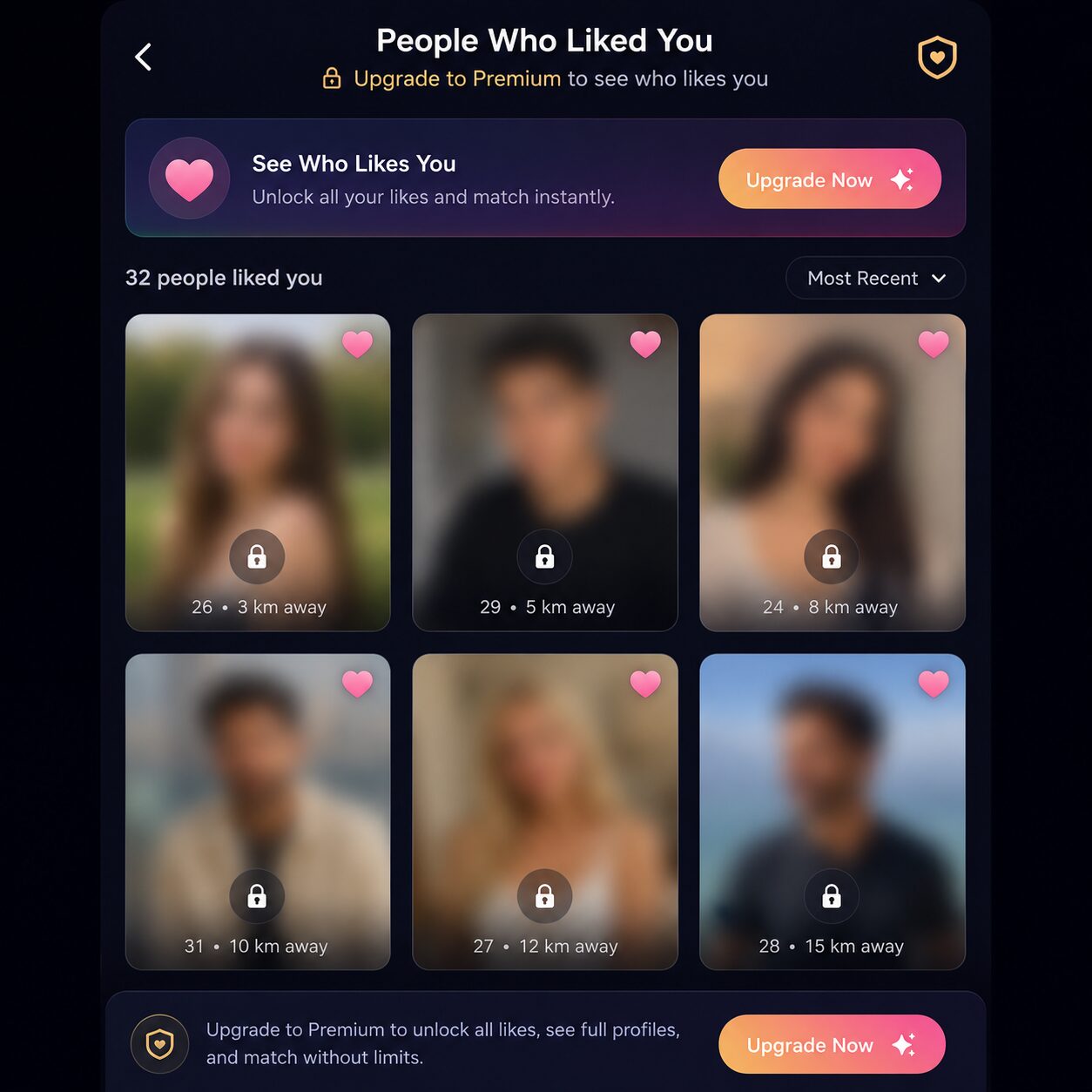
But instead of showing you who it is, it blurs their face, hides their profile, and asks for money.
That is not matchmaking.
That is a ransom note.
And yes, I know the business argument. Apps need revenue. Servers cost money. Engineers enjoy eating. We also like eating. We are not running SciMatch on fairy dust and founder delusion.
But there is a difference between charging for extra value and charging people to remove obstacles the product deliberately created.
That difference matters.
What “Who Liked You” actually does
“Who Liked You” is not some luxury feature.
It is not VIP access to elite romance.
It is not a premium yacht club for emotionally available people.
It is basic information: someone already showed interest in you.
That helps users do three very practical things:
- 1. Save time by focusing on people already open to connecting.
- 2. Reduce rejection anxiety because interest is no longer completely invisible.
- 3. Match faster when mutual attraction is obvious.
Dating is already emotionally expensive. There is no reason to make it artificially complicated too.
The purpose of a dating app should be increasing the odds that two compatible people actually meet. If a feature directly supports that goal, locking it behind a paywall changes the incentive.
That is the part we reject.
The “friction tax” in modern dating
Here is the phrase I think more people should use:
The friction tax.
A friction tax is when a platform creates an obstacle, then charges you to remove it.
In dating apps, the friction tax shows up as limited likes, limited swipes, hidden incoming interest, blurred profiles, visibility throttling, and “free messaging” that is technically available but practically useless because you cannot get enough matches to use it. The user thinks they’re paying for an advantage. They’re often paying to restore functionality that should have been the default.
That is why “Who Liked You” is such an important feature philosophically. It reveals whether a dating app is truly trying to help users connect — or just trying to stretch the loneliness loop long enough to sell a subscription.
Tiny feature. Big moral test.
How major dating apps handle “Who Liked You”
Pricing changes constantly by country, age, platform, subscription length, promotions, and ongoing in-app tests. Treat the numbers below as typical U.S. monthly estimates in 2026, not fixed truth. The pattern is what matters: in most major apps, seeing who liked you sits behind a paid tier.
| App | Can you see who liked you for free? | Paid tier usually needed | Typical monthly cost / notes |
|---|---|---|---|
| SciMatch | Yes | No | Free — Who Liked You is part of the core dating experience. |
| Tinder | No | Tinder Gold or Platinum | Tinder says its Likes page is available to Gold and Platinum subscribers; 2026 third-party pricing estimates commonly place Gold around $25–$45/month, with dynamic pricing by location and other factors. (Tinder) |
| Bumble | No, to see everyone | Bumble Premium | Bumble says users need Premium to see everyone who liked them, and Forbes listed Bumble Premium at $69.99/month in a 2026 review. Bumble also notes pricing varies by tier, duration, and package. (bumble) |
| Hinge | Partially | Hinge+ or HingeX for all likes at once | Hinge says free users can see one incoming like at a time, while subscribers can see all likes at once; 2026 third-party estimates often list Hinge+ around $29.99–$32.99/month. (Hinge) |
| OkCupid | No, not fully | OkCupid subscription | OkCupid says seeing who likes you without liking them first is reserved for subscribers; 2026 third-party estimates vary widely, with reported monthly premium pricing from roughly the high teens to $40+ depending on plan and source. (OkCupid) |
Again, the exact dollar amount is not the main point.
The model is.
Most apps treat incoming interest as premium intelligence.
We treat it as a connection signal.
Can you see who liked you on Tinder or Bumble without paying?
This is one of the most-searched questions in the dating-app category, which already tells you something about how the model feels from the user’s side. The honest answer in 2026: on most major apps, there is no official free way to see your full Likes list.
Tinder’s Likes You page sits behind Gold and Platinum. Bumble requires Premium to see everyone who liked you. Hinge is a partial exception — free users see one incoming like at a time, and a subscription lets you see all of them at once.
The workarounds people share online mostly fall into a few categories. Some are manual: changing your distance filter, scrolling carefully through your stack to spot whoever matches the blurred preview, or waiting for the person to show up naturally as you swipe. These don’t really “unlock” anything — you’re just guessing. Some are technical: browser inspector tricks, third-party tools, scraped APIs. These tend to break after app updates and can get your account flagged or banned, which is a steep price for a hint about one stranger.
The only consistently safe free method is to keep using the app and hope the person reappears in your feed. Which is a roundabout way of saying the apps have correctly identified that you’ll either pay, give up, or settle for guessing.
This is the part of dating-app design we wanted to opt out of. SciMatch shows you who liked you, in full, without a subscription. If someone tapped that button, you get to see the profile. No workaround required.
Why other apps probably won’t make it free
Let’s not pretend this is complicated.
Other apps do not keep “Who Liked You” behind a paywall because it is technically difficult to show. They already have the data. The like exists. The person exists. The app knows.
The blur is the business model.
That feature sits on top of emotional tension and converts beautifully. People want to know who liked them, whether the person is someone they’d actually be excited about, whether they’re missing someone good.
That curiosity converts.
From a pure revenue standpoint, it is brilliant. Slightly evil genius, but genius.
The problem is what it does to the product. When your revenue depends on withholding connection, every other decision starts bending around that incentive. You design for sustained mild anxiety. You optimize for the moment a user is just informed enough to feel something, but not informed enough to act. At scale, that makes everyone slightly worse at meeting each other.
SciMatch philosophy: monetize personal help, not blockage
Here is the line we draw:
We should make money when we help you date better — not when we block you from dating normally.
That is why SciMatch keeps core connection features free, including:
- ✅ Unlimited swipes & likes — no daily cap
- ✅ Free messaging
- ✅ See who liked you — no paywall, no blur
- ✅ Advanced filters — free
And when we do charge, it is for optional AI tools that create new value:
- 💡 understand your relationship compatibility with anyone
- 💡get personal matchmaking support without the $50K price tag
- 💡get help with texting anxiety
- 💡write better messages
- 💡improve your dating profile
- 💡decode whether a conversation has real potential
- 💡understand your personality and dating patterns
- 💡avoid wasting months on the wrong people
That is the difference. We monetize personal help, not romantic friction.
If you pay for a deeper AI analysis, you are paying for intelligence the app created for you.
If you pay to see someone who already liked you, you are paying to unlock information that was deliberately hidden from you.
One model creates value.
The other removes a wall.
We prefer the first.
Why “Who Liked You” being free changes user psychology
People underestimate how much dating-app design affects behavior.
When likes are hidden, users often become more reactive:
- they swipe more impulsively
- they second-guess themselves
- they feel artificially scarce
- they chase validation instead of connection
- they upgrade out of anxiety, not desire
That is bad for dating.
It pushes people into a scarcity mindset. And scarcity rarely makes humans more romantic. It makes us weird.
When “Who Liked You” is visible, something changes:
You can slow down.
You can choose.
You can make decisions based on actual signals instead of app-manufactured mystery.
It is a small design choice with a big emotional effect.
In relationship science, responsiveness matters. People bond when they feel seen, acknowledged, and responded to. So why would a dating app hide the very first evidence of responsiveness?
That is the contradiction.
Apps say they want connection.
Then they blur it.
What “Who Liked You” being free means in practice
It’s not a feature flag, it’s a commitment that shapes everything else on the roadmap. We won’t hide obvious connection signals from users. We won’t charge to remove friction we put in the way. We won’t make basic dating artificially harder so a premium tier feels necessary. Monetization stays on tools that genuinely help.
That doesn’t promise anyone love. It promises the app won’t make the path harder just so it can sell a shortcut. In a different decade that wouldn’t be remarkable. In this one, “you can see who likes you without paying” reads like a small rebellion, which is mostly an indictment of the category.
Final word: connection should not be premium
We made “Who Liked You” free because it helps people connect, and that’s the part of the product we never wanted to monetize.
Not because we hate revenue. Revenue is delightful. We recommend it.
We made it free because it is the right side of the line.
Dating apps should make money by helping people become better daters, make better choices, and understand compatibility more deeply.
Not by hiding the people who already raised their hand.
So yes, SciMatch will monetize optional AI tools.
But we will not sell you back your own connection.
That is the pledge.
And if the rest of the industry thinks that is bad business?
Good.
Maybe dating needs less business-as-usual.
FAQ. Why SciMatch Made Who Liked You Free
Yes. SciMatch lets users see who liked them for free as part of the core dating experience.
–
Many dating apps treat incoming interest as a premium feature because curiosity and uncertainty can drive subscriptions.
–
Yes. SciMatch keeps core dating features like matching and messaging free.
–
SciMatch offers optional AI tools, such as profile help, compatibility insights, conversation coaching, and personalized matchmaking support.
–
Yes. SciMatch offers core dating features 100% free.