
You can still open Hinge.
Your profile looks normal. You can browse, send Likes and stare at your carefully rewritten prompts until they begin to look like a hostage note.
But nothing comes back.
No incoming Likes.
No matches from the Likes you send.
No obvious warning.
Just silence.
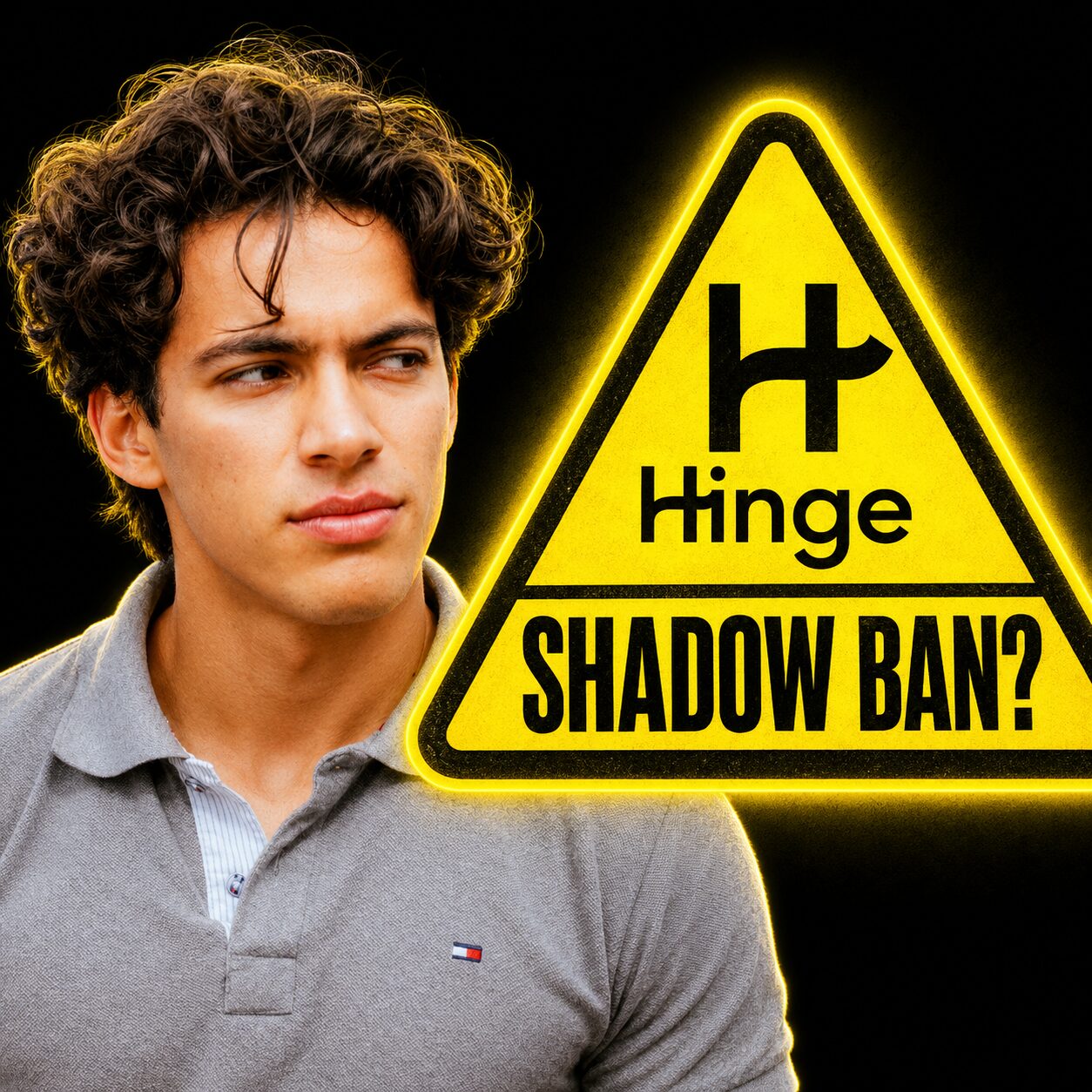
Naturally, you start googling “hinge shadowban,” wondering whether you are shadowbanned on Hinge.
Possibly.
But the more useful answer is that several very different problems can make you feel shadowbanned on Hinge, and only one of them resembles a traditional hidden account restriction.
You might have:
- a real moderation or account problem;
- a technical bug preventing your profile from being distributed;
- a weak profile that is being seen but not selected;
- poor placement inside other users’ Like queues;
- a narrow recommendation pool created by filters and limited inventory;
- or an algorithm that has learned that your preferred pairings rarely become mutual.
These mechanisms are different.
To the user, however, they all feel the same:
That is the phenomenon this article investigates.
Does Hinge actually shadowban?
Hinge does not use the word “shadowban” anywhere, and it has never confirmed a deliberate policy of secretly hiding accounts in good standing.
What Hinge does confirm is narrower, and worth knowing:
- Removed content can hide you. If Hinge’s moderation removes a photo or prompt from your profile, Hinge confirms you can be excluded from Discover and Standouts until you replace it. That is the closest thing to an official, documented “shadowban” — and it comes with a notification, not silence.
- Bans are real bans. If your account is banned, you’ll know. That’s not a shadowban; that’s the front door being closed.
Everything beyond that lives in the algorithm. And this is where the honest answer gets more interesting than either “yes, Hinge shadowbans” or “no, you’re imagining it.”
The four problems people call a “shadowban”
When someone types “am I shadowbanned on Hinge” into Google, they’re usually experiencing one of four different problems. They feel identical. They are not.
| 1. An actual restriction. | Hinge removed content or restricted your account for a moderation, spam, or safety reason. Rare, and usually accompanied by some signal — a removed photo, a warning, a ban message. |
|---|---|
| 2. Low distribution. | Your profile is fully eligible but ranked behind stronger alternatives. You’re in the store; you’re on the bottom shelf. |
| 3. Low conversion. | People do see you. They pass. The algorithm isn’t hiding you — the first photo is losing the human decision in two seconds. |
| 4. Recommendation trapping. | You keep seeing the same recycled, unsuitable profiles because the system has become confident about where you “belong” — and stopped exploring. |
These need different fixes, which is why generic “how to remove a Hinge shadowban” advice fails so often. Delete-and-restart does nothing for problem 3. New photos don’t fix problem 1. Before you do anything, figure out which one you have (there’s a diagnostic below).
Signs you’re shadowbanned on Hinge — the real checklist
Forget the mystical stuff. Here’s what actually distinguishes a genuine restriction from ordinary algorithmic obscurity:
Points toward an actual restriction:
- You received a notice that a photo or prompt was removed and haven’t replaced it
- Your likes stopped sending (people who previously matched report never seeing them)
- Activity dropped to literal zero overnight after months of some baseline — not low, zero
- You recently mass-liked, spam-messaged, got reported, or recreated accounts repeatedly to dodge something
Points toward algorithmic invisibility (far more common):
- A slow fade rather than a cliff: fewer likes each month, staler feed
- The likes you do get seem wildly off-target
- The same profiles keep recycling in Discover
- Sudden temporary improvement whenever you’re newly active, then decay
- Everything works — it just works badly
If your symptoms sit in the second list, you are not banned. You’re experiencing something that deserves its own name.
Algorithmic invisibility: the shadowban that isn’t one
Here’s our honest position after digging through Hinge’s own documentation, its patents, and hundreds of community reports: Hinge doesn’t need to shadowban you for you to disappear.
Hinge says its Discover feed is built on mutual interest — people who fit your preferences and whose preferences you fit — and that its recommendations learn from likes, skips, and activity. Hinge explicitly confirms that skipping profiles informs its algorithm.
Now follow the logic of a system like that when your profile sends weak signals:
- Your profile starts with weak response signals. Maybe the first photo is soft, your intentions read unclear, or you consistently like the most competed-for profiles on the app. Those people rarely like back — not necessarily because you’re unattractive, but because they have hundreds of options. Research on online dating has documented a clear desirability hierarchy where response probability drops as the desirability gap widens.
- The system lowers its confidence in your pairings. It learns: “this user likes Group A; Group A rarely likes this user back.”
- You receive less valuable exposure. Not zero exposure — worse exposure. Fewer highly sought-after users see you. You appear less prominently. Your like lands at position #147 in someone’s queue.
- Weak exposure produces weak results, which confirms the prediction. Fewer good opportunities → fewer likes → the algorithm concludes it was right about you. Academic work on dating recommenders has found that popularity increases a profile’s chance of being recommended — a structural disadvantage for less-popular profiles.
The loop closes: weak response → lower predicted reciprocity → weaker distribution → fewer responses → even lower predicted reciprocity.
A true shadowban would mean Hinge deliberately suppressing your account without telling you. What we’re describing is better called algorithmic invisibility or soft distribution suppression. Nobody decided to hide you. The recommendation system simply concluded that showing you in certain rooms was unlikely to produce a match — and quietly stopped.
From inside the experience, the two are indistinguishable. That’s the trap.
Dating apps don’t need to shadowban you to make you functionally invisible. If the algorithm predicts that the people you want are unlikely to want you back, it can quietly reduce the quality and frequency of your exposure. You remain on the app — but increasingly outside the rooms where the people you want are being shown.
(Why the algorithm makes these predictions in the first place — the Elo question, the “leagues” question, the Nobel Prize marketing — is its own rabbit hole. We’ve taken it apart in our Hinge algorithm deep dive.)
The uncomfortable evidence: Hinge sells the way out
Here’s where we get opinionated, because the facts allow it.
Hinge publicly confirms all of the following:
- Attention is not distributed equally. Standouts is explicitly a feed of profiles “catching the most attention.” Hinge formally identifies its high-demand inventory and puts it behind Roses.
- Feed position matters. Discover is ranked, and HingeX moves subscribers toward the top of other users’ feeds.
- You can pay to jump the queue. Roses go to the top of someone’s Likes You screen. Priority Likes stay near the top for seven days. A Boost buys one hour of extra visibility; a Superboost buys 24.
- All of it is temporary by design. The Boost expires. The subscription lapses. Your profile returns to ordinary distribution.
None of this proves the darkest theory — that Hinge deliberately buries free users in a hidden basement until they pay. A struggling profile might be intentionally suppressed, or simply outranked, or stuck in a low-probability pool. From the outside, those produce the same experience, and Hinge doesn’t publish the machinery.
But it proves something Hinge would rather not phrase this way: there is a queue, position in the queue determines your dating life, and the company charges money to move you up it.
Standouts and Roses don’t prove there’s a secret basement. They prove there’s an upstairs — and that Hinge sells access to the elevator.
Which also explains why paying so often disappoints. A Rose or a Boost can solve an exposure problem (“the person never saw me”). It cannot solve a conversion problem (“the person saw me and didn’t choose me”). When the paid priority expires and nothing underneath has changed, the old results come back — and the app is right there to sell you another Boost. Weak organic results → feeling invisible → buying visibility → brief lift → decay → buying again. If that cycle sounds familiar, the product isn’t broken. You’re just using it as a treatment when it only works as a test.
“I did a Fresh Start and suddenly got likes” — what resets actually reveal
The strongest evidence that this is distribution, not damnation, comes from what happens when people reset.
The pattern shows up constantly in community reports. One June 2026 Reddit account described using Fresh Start and getting seven or eight incoming likes immediately and roughly fifteen matches that day — followed by a return to zero the next day. Others report that after a reset, people previously locked away in Standouts started appearing in the regular Discover feed. Fast Company documented dating coaches and users reporting sudden influxes of better profiles and matches after Fresh Start.
Notice what users report isn’t just more likes — it’s a temporary upgrade in the quality of the candidate pool. The upstairs, briefly.
The most plausible explanation is what recommender-system researchers call the cold-start problem: after a reset, the system has less confidence in its old classification of you, so it explores — shows you (and shows you to) a broader, better-mixed pool while it gathers new data. A Match Group patent describing recommendation resets explicitly discusses clearing likes and skips, resurfacing dismissed profiles, and potentially promoting reset profiles. Patents describe possibilities, not the confirmed live system — but the mechanism fits the reports almost perfectly.
Then the reports split, and the split is the lesson. Some users say the improvement held. Many say the same people reappeared and didn’t match the second time either, making the reset useless. The difference is almost always whether anything changed before the reset.
Because here’s what a reset actually does: it makes the algorithm forget its conclusion. It does not change the evidence that produced the conclusion. Present the same photos to the same pool with the same liking behavior, and the system rebuilds the same model of you — often faster than before.
You may not be shadowbanned. The app may simply have learned where it thinks you belong — and starting over only makes it forget temporarily.
How to fix a Hinge shadowban (real or perceived)
Step 0: Rule out the real thing
Check for removed-content notifications and replace anything flagged — Hinge confirms this restores Discover eligibility. If you’re actually banned, appeal it; recreating accounts to evade a ban is how you get a permanent problem. Two minutes, done. Everything below assumes your account is in good standing.
Step 1: Diagnose which problem you have
Run the paid-visibility diagnostic once, as an experiment, not a treatment — ideally after Step 2:
| Likes and matches spike during a Boost → | your profile converts when seen. Distribution was the bottleneck. |
|---|---|
| Boost runs, likes stay flat → | people are seeing you and passing. This is conversion, not visibility, and no reset will fix it. |
| More likes, but from people you don’t want → | exposure improved; targeting and positioning are off. |
| Everything improves, then collapses when the Boost ends → | you changed your queue position, not your recommendation status. |
Step 2: Change the evidence before you change the address
Never reset a bad profile. This is the single most common mistake: deleting an unsuccessful account and recreating the same unsuccessful profile. Same first photo, same vague prompts, same filters, same habit of chasing the top 5% — same outcome, rebuilt at machine speed.
Before any reset: replace the first photo, replace the two weakest supporting photos, rewrite the prompts, make your relationship intention legible, and loosen one or two non-essential filters. (If you keep seeing the same fifty people on repeat, your “shadowban” may partly be a filter prison of your own construction — a narrow age range, a tiny radius, and three stacked dealbreakers can shrink a city of millions to a few hundred candidates. The app recycles because there’s nothing left to show you.)
Not sure if your profile is the real problem? Don’t delete and restart blindly. Our Hinge profile rater analyzes your photos, prompts, bio, overall positioning, the impression you make, and what may be turning matches away. Find out exactly what to fix before you burn a reset on the same profile.
Step 3: The controlled Fresh Start
With the rebuilt profile in place, use Fresh Start (when Hinge offers it — it refreshes Discover while keeping your profile and matches). Then treat the next 7–14 days as an audition, because if a new-account exploration window exists, this is when the system is re-deciding who you are:
- Like only people you’d genuinely meet
- Don’t mass-reject hundreds of profiles in a sitting
- Add comments to the likes that matter
- Reply to promising matches; don’t collect trophies
- Keep your filters stable
You’re not just looking for a date that week. You’re generating the training data that determines your next six months of distribution.
Step 4: The deep reboot (last resort)
If a rebuilt profile plus Fresh Start still leaves the account stagnant, delete the account properly — not just the app — and stay gone at least 90 days.
Why 90? Not because day 91 triggers algorithmic amnesia. Nobody outside Hinge can promise that, and Hinge’s privacy policy is explicit that while your profile and chats leave the active service at deletion, various backend records persist — a three-month safety-retention window, some data for a year, and evidence that a previous account existed for up to three years. Anyone selling you “the 90-day reset that wipes your Elo” is guessing.
Ninety days is right for humbler reasons: it clears Hinge’s stated safety-retention window, the local dating pool genuinely turns over, and it stops you from impulsively recreating the same profile in a weekend. Use the time. Diagnose what you were chasing and what chased you. Rebuild the photos. Test the new presentation somewhere else — another app, actual life. Then return and behave like Step 3 from day one.
The three-month break isn’t only time for Hinge to forget you. It’s time for you to stop repeating the person Hinge remembers.
Hinge shadowban FAQ
Does Hinge shadowban accounts?
Not in the way people usually mean. Hinge confirms that removed content can exclude you from Discover and Standouts until replaced, and banned accounts are told they’re banned. There’s no evidence of a secret policy of hiding accounts in good standing — but the recommendation system can reduce your distribution so much it feels identical. See the algorithmic-invisibility section above.
How do I know if I’m shadowbanned on Hinge?
Cliff vs. fade. An overnight drop to absolute zero after a moderation event points to a real restriction — check for removed-content notices. A gradual decline with occasional off-target likes is ranking, not restriction. The Boost diagnostic settles it: if paid visibility produces likes, you were never hidden.
How long does a Hinge shadowban last?
A content-removal restriction lasts until you replace the removed content — it’s in your hands. Algorithmic invisibility lasts as long as the evidence that created it: no fixed sentence, no expiry date, and waiting alone doesn’t end it.
Is getting no likes on Hinge a shadowban?
Usually not. Zero likes has four possible causes — restriction, low distribution, low conversion, or a filter-starved local pool — and only the first is anything like a ban. We break down every cause and fix in why you’re getting no likes on Hinge.
Does deleting and remaking your Hinge account remove a shadowban?
It can produce a temporary lift that looks like an un-banning — likely a cold-start exploration window, not a cleared flag. If the profile and behavior return unchanged, users consistently report the lift dying within days. And if you’re recreating to evade an actual ban, expect it to end badly.
Does Hinge shadowban you for resetting too often?
Hinge hasn’t said. Repeated rapid recreations do resemble the account-cycling behavior trust-and-safety systems watch for, so it’s one of the few things here we’d flatly advise against on risk alone.