
Best AI Dating Apps in 2026 for Smarter Matching
Best AI Dating Apps in 2026: What Actually Makes Dating Smarter?
Quick Answer
If you want the quick answer: SciMatch is the strongest overall pick for AI matchmaking because it combines self-awareness, compatibility, and dating support in one app. iris Dating focuses on visual attraction, Keeper is best for human matchmaking with AI support, and Ditto and Known both focus on swipeless, AI chat-based introductions — but Ditto is designed for college students.
The best AI dating apps in 2026 are not just apps that “use AI” somewhere in the basement to verify profiles or recommend matches. That was the old model.
The new wave gives AI a much bigger job: to understand you, coach you, learn from your dating patterns, and help match you with people who may actually fit your personality, attraction style, and relationship goals.
In other words, a smart AI dating app should not just ask:
“Who looks hot?”
It should ask:
“Who are you when you date? What do you keep repeating? What kind of connection would actually make your nervous system stop auditioning for a reality show?”
By that definition, apps like SciMatch, iris Dating, Keeper, Ditto, and Known are more relevant to the AI dating conversation than texting tools, AI companions, or legacy apps with one shiny AI feature taped to the hood.
Best AI Dating Apps in 2026 at a Glance
- Best overall AI matchmaker for compatibility, self-awareness, and dating support: SciMatch
- Best for visual attraction matching: iris Dating
- Best for human matchmaking with AI support: Keeper
- Best for College Students Who Want Slower, AI-Curated Dating: Ditto
- Best for swipeless, voice-first discovery: Known
This list focuses on apps where AI is central to matching, compatibility, or dating guidance — not just profile verification, chatbot openers, or safety tools.
How We Chose the Best AI Dating App. What Counts as a True AI Dating App in 2026?
Let’s retire the lazy definition.
An app is not a “smart dating app” just because it has a chatbot, writes opening lines, or says “AI-powered” on the landing page next to a shiny gradient.
For this guide, we focused on dating apps where AI is actually central to the dating experience — not just taped onto the product as a novelty feature.
A real AI dating app should use AI to do at least one of these things:
- ✔️ match real people with each other
- ✔️ analyze compatibility beyond surface preferences
- ✔️ learn attraction, personality, or dating patterns
- ✔️ improve recommendations through ongoing feedback
- ✔️ guide users toward better relationship decisions
- ✔️ reduce swipe fatigue through smarter curation
- ✔️ help users choose better, not just swipe faster
In other words, the question is not:
“Does this app use AI?”
That bar is now on the floor.
The better question is:
“Does this AI actually make dating smarter?”
That is why we prioritized apps that use AI to improve real dating outcomes — compatibility, self-awareness, curation, attraction learning, and relationship decision-making — over tools that simply generate profile bios, write openers, or add a chatbot to a traditional swipe app.
That matters because “AI dating app” is becoming a crowded phrase. Some apps use AI behind the scenes. Some use AI as a gimmick. The best ones use AI to make dating more intentional.
AI Has Been in Dating for Years. This Is Different.
AI in dating is not new.
Dating apps have used machine learning for years to detect scams, verify profiles, rank recommendations, and learn from user behavior. That kind of AI is useful. Nobody wants to flirt with a scammer named “Jessica” who is actually a server farm wearing lipstick.
But that kind of AI is mostly infrastructure AI.
It works behind the scenes. It protects the app. It predicts behavior. It improves sorting.
The new wave of AI dating apps is different.
Now AI is moving from the basement to the front seat. It is becoming the matchmaker, the dating coach, the emotional pattern detector, and occasionally the brutally honest friend who says:
“You keep choosing emotionally unavailable people because they feel familiar, not because they are special.”
Rude? Yes. Useful? Also yes.
So for this guide, we are focusing on apps where AI is central to matching real people or guiding the human dating journey.
The TikTok Prompt Trend Explains the Whole Shift
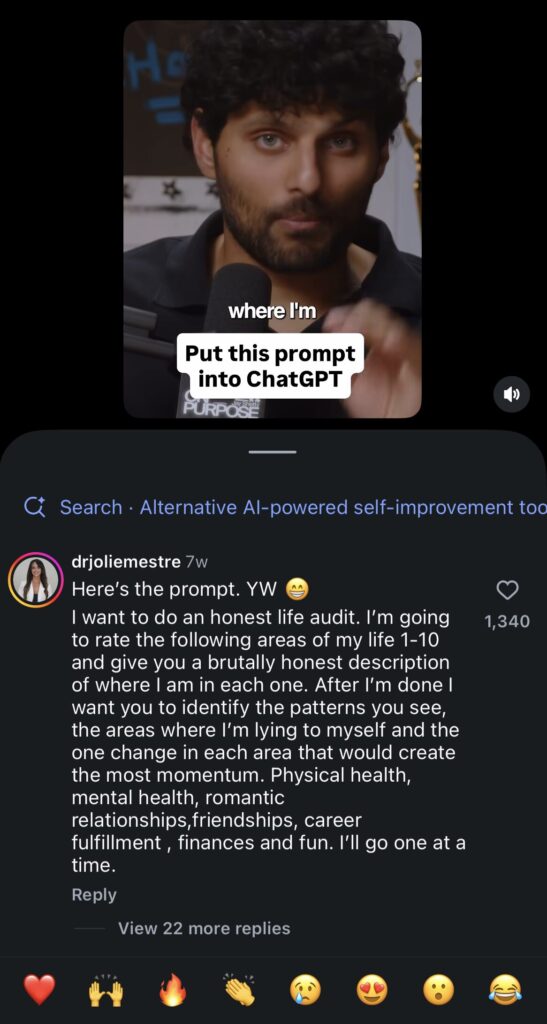
You have probably seen the viral self-audit prompts on Instagram or TikTok.
Someone posts:
“Put this into ChatGPT: I want to do an honest life audit. I’ll rate my physical health, mental health, romantic relationships, career, finances, friendships, and fun. Then identify the patterns, where I’m lying to myself, and one change that would create momentum.”
And people go wild because AI does something that feels almost magical:
It organizes the mess.
That is the power of AI right now. It can notice patterns. It can take vague feelings and turn them into something you can actually work with.
Dating needs exactly that.
Because most dating problems are not just “there are no good people.”
They are:
- ‼️ You keep choosing the same person in a different outfit.
- ‼️ You confuse anxiety with attraction.
- ‼️ Your profile attracts people you do not actually want.
- ‼️ You say you want stability, then chase emotional turbulence with cheekbones.
- ‼️ You text like a hostage negotiator and call it “chemistry.”
- ‼️ You do not know what your dating behavior is telling people.
The best AI dating apps are not just trying to show you more profiles. They are trying to help you understand yourself well enough to choose better.
That is the real category shift — if the AI is built well.
Best AI Dating Apps in 2026: Quick Comparison
| App | AI Role | Best For | Limitation |
|---|---|---|---|
| SciMatch | AI matchmaker using facial compatibility signals, personality insights, and dating support | Compatibility, self-awareness, and smarter matchmaking | Smaller pool than legacy giants |
| iris Dating | Learns visual attraction preferences from faces | People who want AI to predict physical attraction | More focused on attraction than full relationship guidance |
| Keeper | AI-assisted matchmaking with human matchmaker support | Serious long-term relationships | More structured and selective; may feel heavy for casual daters |
| Ditto | AI-curated matches and real-date coordination for college students | Students tired of swiping | Campus density matters |
| Known | Swipeless matching, voice-based AI onboarding | People who want voice-based onboarding | Early-stage / limited availability/smaller pool |
Why Relationship Science Matters in Dating Apps
Relationship research is humbling, which is annoying because humans prefer mythology.
We like to say love is fate. Sparks. Timing. “When you know, you know.”
Cute. Also incomplete.
A major machine-learning study led by Samantha Joel analyzed relationship quality predictors across 43 longitudinal couple datasets. The study found that relationship-specific factors — like perceived partner commitment, appreciation, conflict, sexual satisfaction, and perceived partner satisfaction — were among the strongest predictors of relationship quality. Individual traits like attachment anxiety and avoidance also mattered. (PNAS)
Normal-person translation:
It is not enough that someone is hot, nearby, and also likes tacos.
Better matching should consider:
- ✅ how people communicate
- ✅ how they handle closeness
- ✅ whether they feel appreciated
- ✅ whether they repair conflict
- ✅ whether they are emotionally available
- ✅ whether their relationship patterns actually fit
This is why the next wave of AI dating is interesting. AI can process more signals than a human matchmaker can hold in their head, while relationship science gives the system a better target than “both people like hiking.”
Hiking is nice.
It will not save you from avoidant attachment.
SciMatch — Best Overall for Compatibility and Self-Awareness
Most dating apps start with:
“Who do you want?”
SciMatch starts closer to:
“Who are you when you date?”
That is a better question. Slightly more uncomfortable, but better.
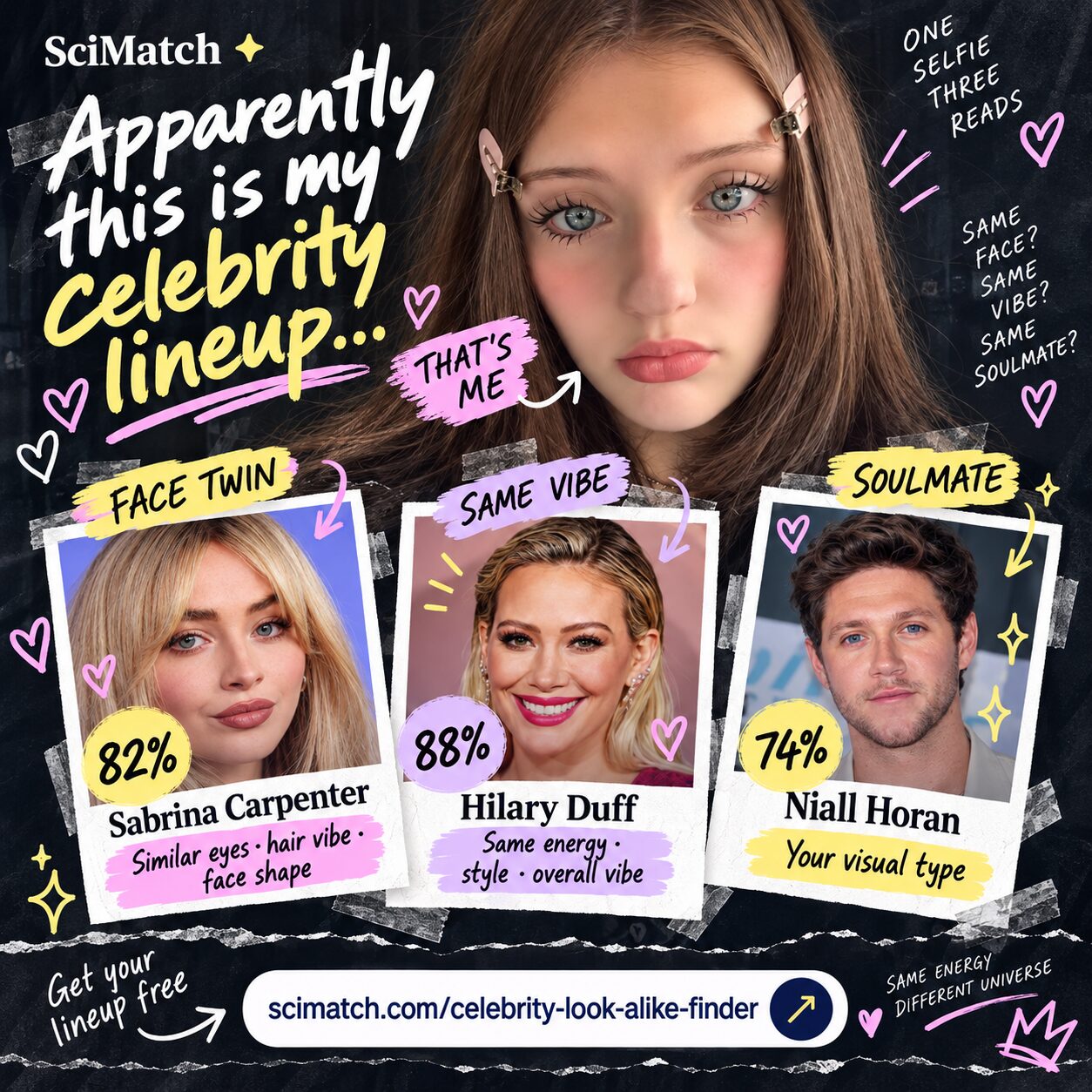
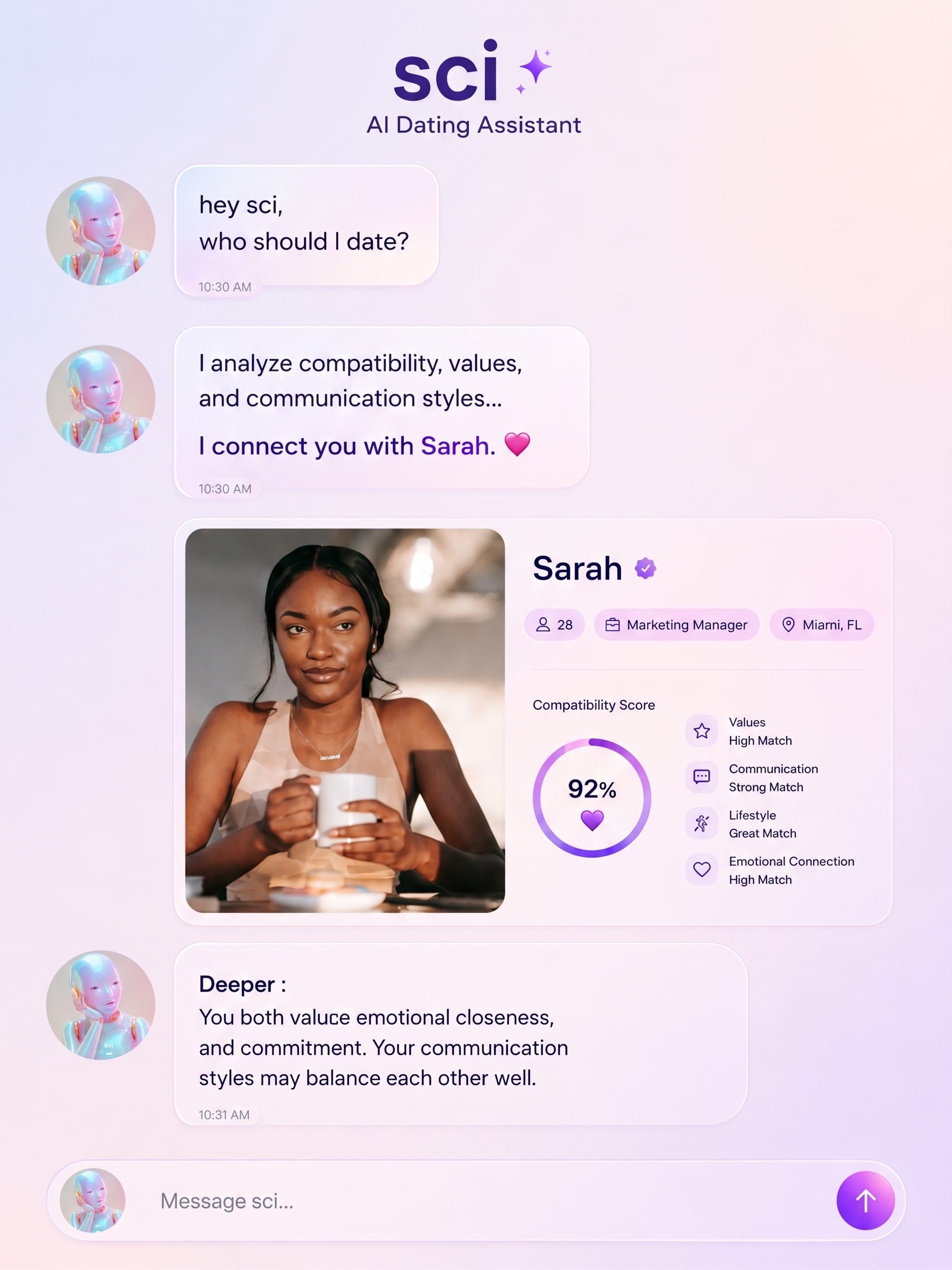
SciMatch is an AI dating app built around the idea that better matches start with deeper self-understanding. The most intriguing part is that SciMatch doesn’t rely only on bios, prompts, or swipe behavior. It uses face-based compatibility signals and deeper, friendly conversations with its AI matchmaker, Sci, to help users understand their personality, dating patterns, and who they may be truly compatible with.
That matters because dating profiles are highly curated — especially in the era of AI-polished dating profiles.
A bio can lie.
Prompts can be optimized.
Someone can write “emotionally available” while treating vulnerability like a cybersecurity breach.
Faces don’t lie.
Facial, behavioral, and personality signals are not destiny. No serious app should pretend they are. But they can become part of a richer compatibility model — especially when combined with AI friend that learns from the user over time.
So SciMatch is interesting because it’s not just:
“Here are 200 people. Good luck in the emotional Hunger Games.”
It’s more like:
“Here is who you are. Here is who you tend to choose. Here is why that may or may not work. And here are people who may fit you better.”
That includes:
- ⚫️ Facial compatibility
- ⚫️ Self-awareness before matching
- ⚫️ AI matchmaking for deeper relationship signals
- ⚫️ Personality-based compatibility insights
- ⚫️ Dating support
This is the thesis that makes SciMatch feel AI-native rather than AI-enhanced:
Better matches start with better self-understanding.
That is the “friend + psychologist + matchmaker” model.
Best for
People who want an AI dating app focused on compatibility, personality, self-awareness, and smarter partner choice.
Not best for
People who only want the largest possible dating pool or prefer traditional swipe-first apps.
Fun Fact: Couples Who Look Alike Are Not Just a Meme
You know those couples who look strangely similar and madly in love?
Source: Jay Shetty, Instagram post
Same eyes. Same facial proportions. Same “are you two married or siblings?” energy.
That phenomenon has been studied. A 2020 Scientific Reports study found that spouses’ faces tend to be similar at the beginning of marriage, although the study did not support the idea that couples become more similar-looking over time. (Nature)
This does not mean your soulmate is your facial twin.
It means faces may carry more relational information than people consciously notice. Humans already respond to visual patterns. AI can detect some patterns faster, more consistently, and at scales humans cannot.
That is one reason face-based AI dating is not as strange as it sounds.
Humans have been doing unconscious visual sorting forever.
AI is just less embarrassed about admitting it.
iris Dating — Best for AI Visual Attraction
iris Dating is another AI dating app that uses facial analysis, but its core focus is attraction. Its site says it applies AI to understand who users are attracted to and uses that understanding to present potential matches. Its Google Play listing also says iris learns users’ preferences for facial features as they like or dislike profiles.
That is a clear and useful lane.
iris is strongest at answering:
“Who am I likely to find physically attractive?”
That matters because physical attraction is not random. People have patterns, even when they pretend they are spiritually above having a type.
The limitation is that attraction is only one layer.
Attraction opens the door. Compatibility decides whether anyone should remain in the room.
So iris belongs on this list because it made AI attraction matching central to the product. But its main promise is narrower than full relationship intelligence.
In simple terms:
iris helps with who catches your eye.
SciMatch pushes toward who, among the people who catch your eye, may actually fit your personality.
Both are useful.
Different promise.
Best for
People who want AI to learn their visual attraction patterns.
Not best for
People looking for deeper relationship coaching, emotional pattern analysis, or full compatibility guidance.
Keeper — Best for Serious Long-Term Relationships
Keeper is built for people who are not casually “seeing what’s out there,” which often means “I have no plan and I’m making that everyone’s problem.”
Keeper describes itself as AI-assisted matchmaking for serious, long-term relationships, combining real matchmakers and data. (Keeper) Its FAQ says it is best described as an AI-assisted matchmaking service, not a typical dating app, and that it is focused on love, marriage, and family rather than endless dating.
That puts Keeper closer to professional matchmaking than classic dating apps.
Its advantage is seriousness and structure. It is closer to a modern matchmaking service using AI and human judgment to curate serious options.
That makes Keeper useful for marriage-minded users who want a more selective process.
The trade-off is accessibility and tone. A serious matchmaking product can feel more structured, more selective, and less casual.
Great if you are marriage-minded.
Heavy if you are still saying, “I’m open to seeing where things go.”
Best for
People who are serious about long-term commitment and want a more curated matchmaking process.
Not best for
Casual daters, people who want a lightweight app experience, users who prefer browsing freely, or people who are equally open to casual dating, serious relationships, or seeing where things go without choosing a clear direction yet.
Ditto — Best AI Dating App for College Students
Ditto is interesting because it attacks one of the stupidest parts of modern dating:
Endless swiping that does not turn into actual dates.
Ditto targets college students and uses AI to match users based on profile inputs and feedback from past dates. Business Insider reported that Ditto delivers curated match suggestions by text, helps organize dates, and had around 42,000 users across California college campuses. (Business Insider)
That niche makes sense.
College dating is uniquely weird. Everyone is nearby. Everyone is socially connected. Everyone is somehow both overexposed and emotionally unavailable.
A product that curates matches and nudges people toward actual dates could solve a real problem.
Ditto’s strength is moving users from:
“We matched.”
to:
“We met.”
That sounds basic, but dating apps have become very good at creating almost-connections.
Chatting.
Liking.
Matching.
Watching someone’s story.
Saying “we should hang soon” until one of you graduates.
Ditto’s limitation is density. Campus-based AI matchmaking only works if enough compatible people are in the system.
A genius matchmaker with five users is just a lonely spreadsheet.
Still, Ditto belongs in this article because it uses AI to curate human matches and push toward real-life interaction — not just better texting.
Best for
College students who want fewer swipes and more actual dates.
Not best for
People outside supported college communities or users who want a large, open dating pool.
Known — Best for Voice-First, Swipeless Dating
Known belongs on this list because it is another app trying to solve endless swiping, using AI voice onboarding, a chatbot-style experience, and introductions instead of a traditional feed.
Instead of sending users straight into a feed of profiles, Known uses a more guided, voice-first process to learn about people before introducing matches. Known’s own site describes the app as “built on knowing you first” and positions itself against endless swiping and dopamine-chase dating. Global Dating Insights also reported that Known uses a voice-based interview conducted by an in-app AI matchmaker, then presents users with one potential match at a time. (Global Dating Insights)
That matters because voice can reveal nuance that checkboxes often miss — tone, hesitation, warmth, confidence, and how someone naturally explains what they want.
Known’s main strength is its swipeless structure.
It slows the dating process down and makes discovery feel more curated instead of turning dating into a thumb workout with emotional consequences.
Rather than asking users to browse hundreds of profiles, Known aims to understand them first and then present fewer, more intentional matches.
Its promise is simple:
Less scrolling, more curation.
And honestly, that alone makes it worth watching — because swipe fatigue is real, and most people do not need more profiles.
They need a better way to find the few profiles that actually matter.
The trade-off? Less chaos also means less control. If you like browsing freely and comparing lots of profiles, a swipeless model may feel restrictive.
Known is best for people who are tired of endless options and willing to trade volume for a more guided experience.
Best for
People who want a slower, swipeless, more intentional dating experience.
Not best for
Users who want full browsing control or immediate access to many profiles.
The Good Side of AI Dating
AI has real potential to improve dating.
Not because AI is magic.
Because dating is overloaded with bad data, bad incentives, and bad self-awareness.
A well-designed AI matchmaker can combine relationship research, behavioral signals, user feedback, and psychology literature into something no human matchmaker could process at scale.
And unlike a human matchmaker, AI does not get annoyed when you say, for the 14th time:
“I want someone emotionally available but also mysterious.”
AI just politely logs the contradiction and adjusts.
That is powerful.
Especially because relationship failure is not rare. The CDC reported 672,502 divorces in 45 reporting states and D.C. in one year means roughly one divorce every 47 seconds.
That is not a tiny niche problem. That is hundreds of thousands of couples discovering that attraction, timing, or “we had chemistry” was not enough.
If better matching and better relationship guidance can help people make wiser partner choices, that matters.
Not in an “AI will eliminate divorce” fantasy way.
In a “maybe fewer people marry their unresolved attachment pattern” way.
Progress.
The Risks of AI Dating
Now for the cold shower.
AI can also make dating worse if it is designed poorly.
It can create false certainty
AI can say “high compatibility,” but humans still need to meet, feel, observe, and choose.
A compatibility score is not a wedding vow.
A compatibility score is not a proposal. It is a better starting point. The rest still belongs to human judgment, chemistry, and how someone actually shows up.
It can reinforce bias
If training data reflects human bias, AI can amplify it.
Dating preferences already contain plenty of bias around beauty, age, race, class, education, and lifestyle.
Apps must actively audit this.
Otherwise, AI does not become smarter.
It just becomes society’s bad habits with better math.
It can become another engagement machine
If AI is used to keep users hooked instead of helping them connect, congratulations.
We just reinvented swipe addiction with better grammar.
The ethics matter.
A lot.
Final Verdict: The Best AI Dating Apps Rebuild the Matching Logic
The most useful AI dating apps in 2026 are not the ones adding a chatbot to old swiping.
They are the ones rebuilding dating around:
- 1. self-awareness
- 2. relationship compatibility
- 3. curated introductions
- 4. fewer dopamine loops
- 5. deeper feedback after matches
That is why apps like SciMatch, iris Dating, Keeper, Ditto, and Known are more interesting for this category than generic texting tools or companion bots.
They are not solving the same problem.
iris decodes attraction:
“Who are you visually drawn to?”
Keeper filters for commitment:
“Who is truly ready for a serious relationship?”
Ditto solves the app-to-date gap:
“How do we turn a match into an actual date?”
Known slows discovery down:
“Can conversation-first introductions work better than an endless profile feed?”
SciMatch goes deeper:
“Who are you beneath your stated preferences, what do you truly need, and who is compatible with that?”
Different angles.
Same bigger shift.
Dating is moving from:
“Show me more people.”
to:
“Help me choose better.”
And honestly?
About time.
Because the future of dating should not be more profiles, more swipes, and more emotionally confusing almost-connections.
The future should be smarter dating.
More self-awareness.
More compatibility.
More actual connection.
And fewer people mistaking chaos for chemistry because someone had nice eyes and replied “haha” at exactly the right moment.
Try SciMatch Free
You can’t find authentic love if you don’t know who you are.
SciMatch uses AI to help you understand your personality, compatibility patterns, and who may actually fit you — before you waste months on the wrong people.
Download SciMatch FreeFAQ: AI Dating Apps in 2026
The best AI dating app depends on what you want. SciMatch is strongest for compatibility and self-awareness, iris Dating focuses on visual attraction, Keeper is built for serious relationships, Ditto helps college students move from matches to dates, and Known offers swipeless, voice-first discovery.
–
An AI dating app uses artificial intelligence to improve matching, compatibility analysis, self awareness, or real-date coordination. The best AI dating apps use AI to help people choose better.
–
AI dating apps can be better when they reduce swipe fatigue, improve compatibility signals, and help users understand their dating patterns. But AI is not a guarantee of chemistry or relationship success.
–
SciMatch is designed around deeper compatibility signals, including personality insights, facial compatibility signals, and AI dating support.
–
iris Dating is focused on using AI to learn visual attraction patterns and recommend people who fit a user’s facial preferences.
–
Known and Ditto are both built around reducing swipe fatigue. Known uses a swipeless, voice-first approach, while Ditto focuses on curated matches and real-date coordination for college students.
–
No. AI can help users notice patterns and make better decisions, but users still need to meet people, observe behavior, and use their own judgment.
–
AI can identify patterns and compatibility signals, but it cannot guarantee relationship success. Healthy relationships still depend on communication, trust, commitment, timing, and mutual effort.
–
Why is SciMatch different from other AI dating apps?
SciMatch focuses on compatibility and self-awareness before matching. Instead of only asking who users are attracted to, SciMatch aims to understand who they are, what they need, and who may actually fit them.
–
Some are free to start, but not all are fully free. SciMatch offers its core dating features for free, including unlimited swipes, likes, messaging, seeing who liked you, and filters. iris is free to sign up for, but offers premium upgrades. Keeper is not really a free dating app; it uses a paid success/per-match model. Ditto is listed as free with in-app purchases. Known uses per-date pricing model.